

 trading
Mastering the Black-Scholes Model: A Comprehensive Guide to Derivative Pricing and Formulas

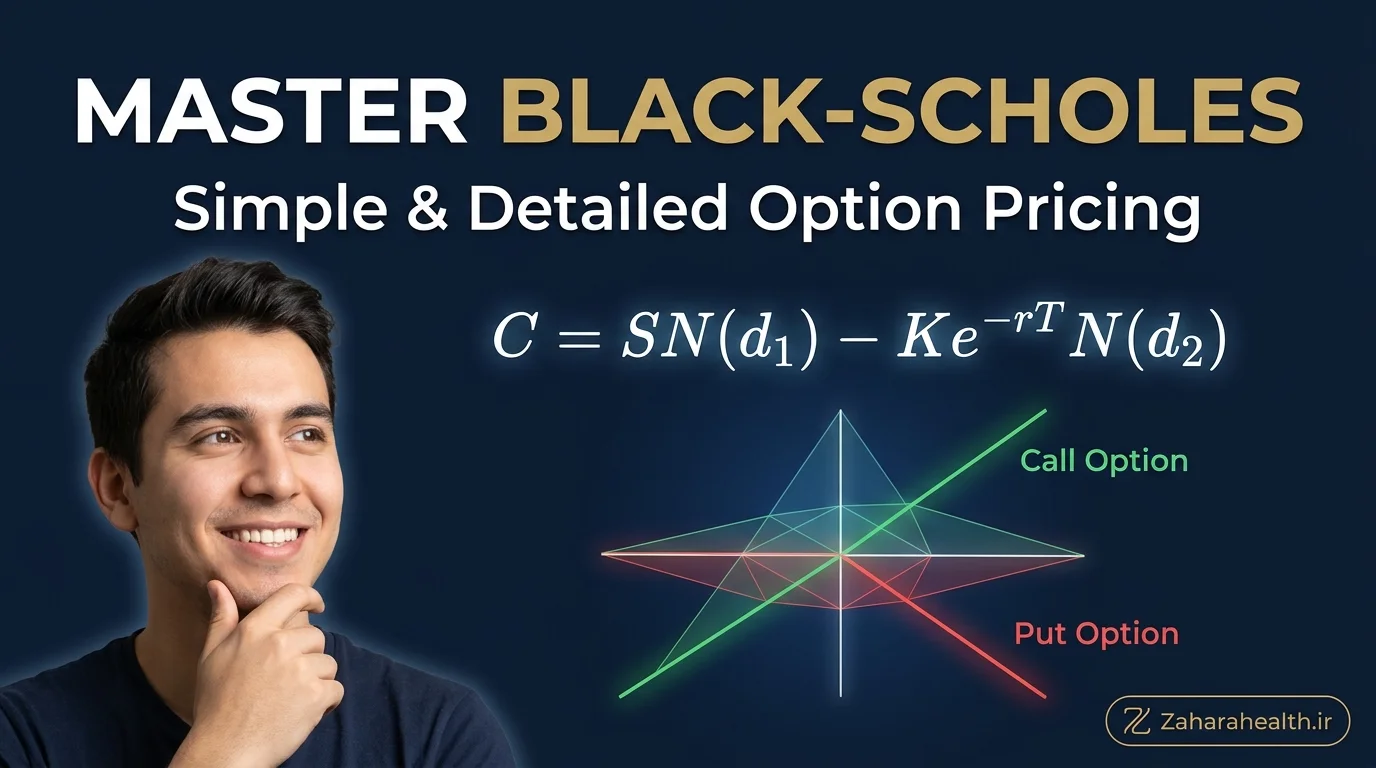
The Black-Scholes model stands as one of the most transformative mathematical frameworks in modern quantitative finance. Developed by Fischer Black, Myron Scholes, and Robert Merton in the early 1970s, it revolutionized financial markets by providing a rigorous, mathematical approach to pricing European-style options. Before its inception, option pricing relied heavily on ad-hoc rules of thumb and intuition. Today, the Black-Scholes formula serves as the foundational benchmark for derivatives trading desks, risk management systems, and volatility analysis across global financial markets.
In this deep-dive article, we break down the core components, stochastic foundations, underlying assumptions, and practical implications of the Black-Scholes formulas.

Advanced Options Trading in plain English | (Options Trading)
Course Specifications
- 18.5 Hours of HD Video Training: Full-length lessons in crisp 1080p resolution with English subtitles.
- Last Updated: February 2023
- File Size: 7.56 GB.
1. The Core Objective: What Does Black-Scholes Solve?
At its heart, the Black-Scholes model answers a fundamental question: What is the fair market price of a European option (call or put) given the current state of the market?
An option grants its holder the right—but not the obligation—to buy (call) or sell (put) an underlying asset at a predetermined strike price (K) at a specific expiration date (T). Because the future price of the underlying asset is inherently uncertain, valuing this contingent claim requires advanced mathematical machinery, moving beyond standard deterministic calculus.
2. Mathematical Foundations and Geometric Brownian Motion
To model how an asset’s price evolves over time, Black and Scholes assumed that the underlying stock price follows Geometric Brownian Motion (GBM). Mathematically, this is expressed as a stochastic differential equation (SDE):
- : The price of the underlying asset at time .
- $\mu$: The expected rate of return (drift) of the asset.
- $\sigma$: The volatility of the asset’s returns (standard deviation).
- $dW_t$: The increment of a standard Brownian motion (Wiener process), introducing random market shocks.
A crucial insight of the model is that the drift parameter ($\mu$) disappears entirely from the final pricing formula. This occurs because the model constructs a risk-free hedged portfolio, making the option’s fair price independent of investor risk preferences.
3. The Black-Scholes Partial Differential Equation (PDE)
By applying —the chain rule for stochastic calculus—to a portfolio consisting of a short option and a dynamically hedged position in the underlying stock, one arrives at the famous Black-Scholes Partial Differential Equation:
- : The price of the option as a function of asset price and time.
- : The constant risk-free interest rate.
- : Theta (time decay).
- : Gamma (curvature sensitivity).
- : Delta (price sensitivity).
4. The Closed-Form Black-Scholes Formulas
Solving the PDE subject to terminal boundary conditions yields the closed-form solutions for European options.
European Call Option Formula:
European Put Option Formula:
Where $N(\cdot)$ represents the cumulative distribution function of the standard normal distribution, and the auxiliary variables $d_1$ and $d_2$ are defined as:
Intuitive Breakdown of the Components:
- : Represents the expected value of receiving the stock upon exercise, weighted by the risk-neutral probability factor ( corresponds to Delta).
- : Represents the present value of the strike payment required to exercise the option.
5. Key Assumptions and Limitations
- Constant Volatility (): Assumes volatility is fixed and known, whereas real markets exhibit volatility smirks.
- Continuous Trading: Assumes portfolios can be rebalanced continuously without transaction costs.
- No Dividends: The basic model assumes the underlying asset pays no dividends.
- Log-Normal Returns: Assumes asset returns are normally distributed, ignoring market crashes and fat tails.
6. Conclusion
The introduction to Black-Scholes formulas marks a cornerstone in quantitative finance. By connecting stochastic differential equations, risk-neutral pricing, and no-arbitrage principles, it provided market participants with a universal language for option valuation. Understanding Black-Scholes remains an absolute prerequisite for mastering advanced financial engineering.